

Blog
Laser Printer vs. Inkjet: Which is Better?

When searching for the ideal printer that combines an affordable price, capabilities, and ease of use, the first thing that comes to mind is comparing the available types to see which one meets your actual needs.
From here, we decided to save you the trouble of searching and confusion; in this article, we review the fundamental differences between laser printers and inkjet printers to help you determine the most suitable option for you.
Read on to learn all the details and the difference between laser and inkjet printers.
inkjet vs laser printer
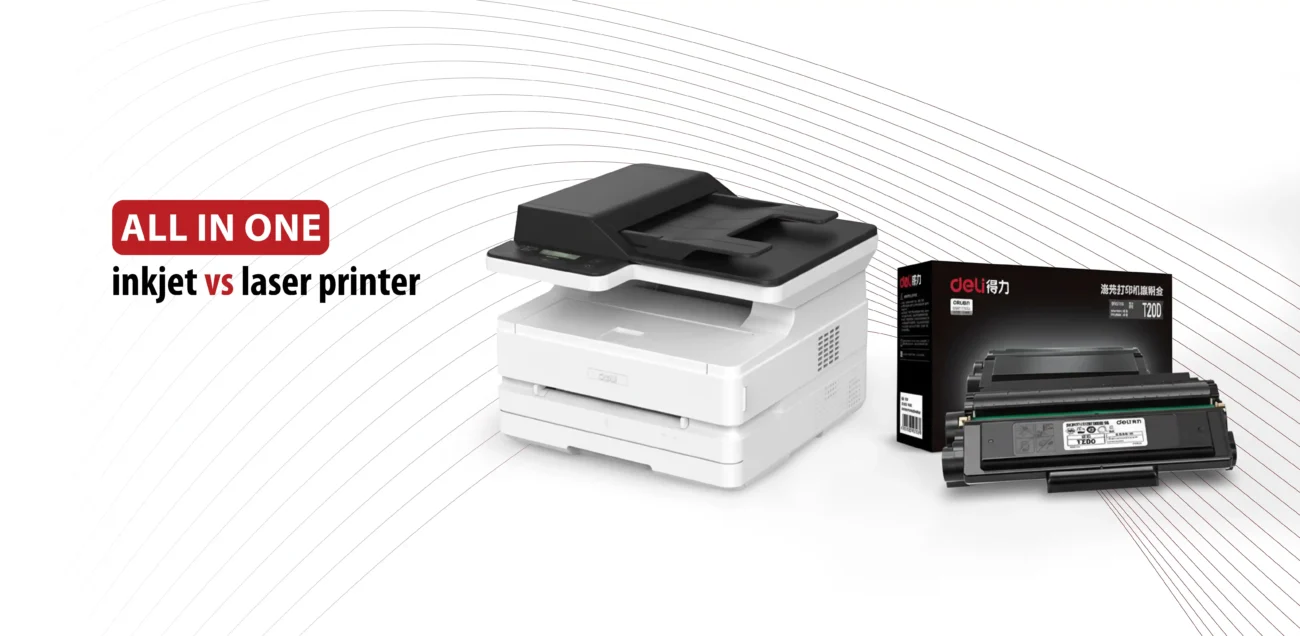
The difference between the two types lies in the fact that inkjet printers use liquid ink, while laser printers contain a fine powder called (toner).
Both inkjet and laser printers require special types of paper to produce high-quality prints. The main difference between the two is that inkjet paper is often coated with a layer of wax or polymer that helps the printer produce smoother and richer colors. As for laser toner, it adheres directly to the paper without any intermediary substance, which is suitable for producing sharp black-and-white prints.
Laser printers are generally preferred for environments where both speed and handling large print volumes are priorities. Their faster printing speeds make them especially suitable for high-volume tasks.
Below, we will explain how both printers work.
Inkjet Printer
Inkjet printers are classified according to their adopted printing technology, with two main categories leading this classification: the first is Continuous Inkjet printers designed for industrial environments, and the second is Drop-on-Demand printers intended for office and personal use. These printers are characterized by their ability to produce color prints and graphics with a high professional standard.
Types of Inkjet Printers
Continuous Inkjet (CIJ): A non-contact technology that fires electrically charged ink droplets, featuring production speeds exceeding 120,000 droplets per second, making it the ideal choice for high-speed production lines.
Thermal Inkjet (TIJ): Relies on heating resistor elements inside the cartridge to generate fine ink droplets ejected toward the printing surface in millionths of a second, providing a perfect balance between high speed and exceptional quality.
Drop-on-Demand (DOD): Dedicated to demanding industrial applications, supporting printing on various surfaces such as wood, metal, plastic, and packaging. It operates via independent valves ranging from 7 to 32 valves that generate droplets as needed to form characters and symbols.
High-Resolution Inkjet Printers: Rely on piezoelectric technology to produce high-sharpness images, with a printing height of up to 100 mm for a single head, and the possibility of exceeding 900 mm when combining multiple heads.
Laser Printers
They are divided into two types: monochrome and color, and they work using dry toner powder that is fused onto the paper via a thermal roller.
They are the ideal choice for printing photos on glossy paper, as the dye ink particles are absorbed beneath the protective layer, achieving a glossy finish. They also lead the options for printing business documents due to their high quality, smudge resistance, and the suitability of their prints for long-term archiving.
Their efficiency is particularly prominent when printing in large volumes, as they achieve a low cost per page compared to others. For this reason, they represent the most suitable solution for homes and small offices with intensive use, given the speed, reliability, and operating economy they provide.
inkjet vs laser printer quality
Here are the most significant differences in print quality between inkjet and laser printers:
Inkjet printers provide superior image quality and vivid colors with smooth blending, making them the most suitable for photos.
Meanwhile, laser printers excel at producing sharp, smudge-resistant text and clear business graphics at high speeds. Inkjet printers use liquid ink, while laser printers rely on dry toner powder, which results in more durable and consistent prints.
Inkjet Printer Quality
We can say that inkjet printers are an ideal choice for printing high-quality photos and documents rich in graphics and images. They significantly outperform their counterparts in color blending and displaying fine details on glossy paper. However, these printers are relatively slower and may produce less sharp text on plain paper.
Key Features of Inkjet Quality:
- Superiority in colors and images.
- High printing resolution.
- Media versatility.
- Borderless printing.
- Text quality.
Print Quality Considerations:
- Generally slower than laser printers, especially when printing full high-quality images.
- Liquid ink can sometimes cause nozzle clogs when not used regularly, requiring cleaning cycles.
- Photo printing requires specialized paper and more ink, which can increase operational costs.
Laser Printer Quality
Laser printers are characterized by producing sharp, smudge-resistant text, making them the ideal choice for professional documents and high-volume printing.
In their operating mechanism, these printers rely on toner powder fused by heat, which grants them higher speed, longer lifespan, and better text precision compared to inkjet, although they are less efficient at printing photographic images.
Key Features of Laser Printer Quality:
- Exceptional at printing black-and-white text and clear lines.
- Capable of printing acceptable colors, but they do not match inkjet printers in high-resolution photographic images.
- Advanced models reach high resolutions for professional color printing, while 600 dpi is considered a sufficient standard for text printing.
- Suitable for busy environments that require production speeds ranging from 20 to 40 pages per minute.
- Ideal for those who want to avoid nozzle clogging and frequent cartridge replacements.
- The perfect choice for contracts, resumes, and marketing materials that require a sleek and polished appearance.
inkjet vs laser printer for photos
Inkjet printers outperform laser printers in photo printing due to their liquid ink, which produces smooth color gradients on glossy paper. Laser printers, while faster and more economical for text, offer lower quality in photo printing.
Inkjet Printers for Photos:
- Unmatched in vibrant colors, fine details, and color blending.
- Support various media types such as glossy paper, matte paper, fabric, and more.
- Ink costs are relatively high, and ink can often dry out if not used regularly.
- Suitable for photographers and creatives.
Laser Printers for Photos:
- Good for graphics and sharp text, but less detailed in photographic images.
- Very fast and cheaper per page when printing in large quantities.
- Toner powder is difficult to blend for photos and is incompatible with heavy glossy paper.
- Most suitable for text documents and professional reports that contain some graphics.
Finally, we can clarify that if the priority is photo printing, choose inkjet; however, if you need to print large volumes of text with occasional color graphics, choose a color laser printer.
inkjet vs laser printer for stickers
We can say that inkjet printers are highly superior in producing vibrant, high-quality stickers, making them the preferred choice for artists and crafters. Laser printers, however, excel in producing large quantities of professional matte stickers with better water resistance and lower long-term costs.
Inkjet Printers for Stickers:
- Capable of highly precise color blending and high-quality printing compatible with various media like glossy and matte vinyl.
- Usually require lamination for water resistance; inkjet prints need a protective spray or lamination.
- Suitable for crafters, artists, and printing photos with vibrant colors.
Laser Printers for Stickers:
- Suitable for high-volume printing, small businesses, and durable stickers.
- Characterized by high printing speeds, water resistance, and low cost per page in the long run.
- Have a higher purchase cost and lower image quality; heat may damage thin vinyl.
- Laser toner is naturally water-resistant.
Conclusion: Inkjet for vibrant colors, and laser for durability and large quantities. Sticker paper specific to each type must be used to avoid damaging the printer.
inkjet vs laser printer which is better for home use?
You can choose an inkjet printer if you print photos, school projects, or color documents in limited quantities. However, if you print large volumes of text or need a printer ready immediately when needed, you can choose a laser printer.
Inkjet printers are most suitable for home users who print photos or documents irregularly, offering a lower purchase cost and better photo quality. Laser printers are ideal for heavy users and home offices that need to print large amounts of text at higher speeds and lower long-term costs.
Inkjet Printers for Home Use:
- Pros: Characterized by a low purchase price, exceptional print quality, and compatibility with multiple paper types.
- Cons: May result in a higher cost per page, with the possibility of nozzle clogging when not in use.
- Best for: Students, printing family photos, and light versatile use.
Laser Printers for Offices and Large Quantities:
- Pros: Characterized by high printing speed, very low cost per page, sharp text, toner that doesn’t dry out, and higher durability.
- Cons: Higher purchase price, larger size, and weaker performance in photo printing.
- Best for: Offices, remote work, and high-volume printing.
In conclusion, after reviewing the fundamental differences between laser and inkjet printers in terms of quality, photo printing, stickers, and more, we at Deli are pleased to be your guide toward the most suitable choice for your needs.
Whether you are looking for a laser printer for high productivity or an inkjet printer for vibrant colors and high-quality photos, you will find a comprehensive range of printers that meet all your requirements.
Browse our store now and choose your perfect printer.